OAuth Device Code Phishing Research and Findings
A short report on OAuth device code phishing, an attack technique that has grown rapidly in 2026. It covers how attackers use real login pages to steal access tokens and bypass MFA.
Threat Intel Findings Online
This attack technique has been very popular in 2026. Campaigns have grown from 15x to 37.5x since early in the year, with 50,000+ observed since March. The surge is driven by Phishing-as-a-Service kits (EvilTokens, Tycoon 2FA, Cali365) that let low-skill attackers run AI-assisted campaigns at scale, targeting small to enterprise clients.
How it works
Victims are lured via email, QR codes, or even compromised Microsoft Teams invites that spoof DocuSign, Microsoft, or Mimecast enrollment prompts. The lure walks them into entering a device code on a legitimate vendor authentication page and approving the consent request. Once approved, the attacker receives a valid access token, without ever needing to enter a password or complete MFA themselves.
Flow Chain Example
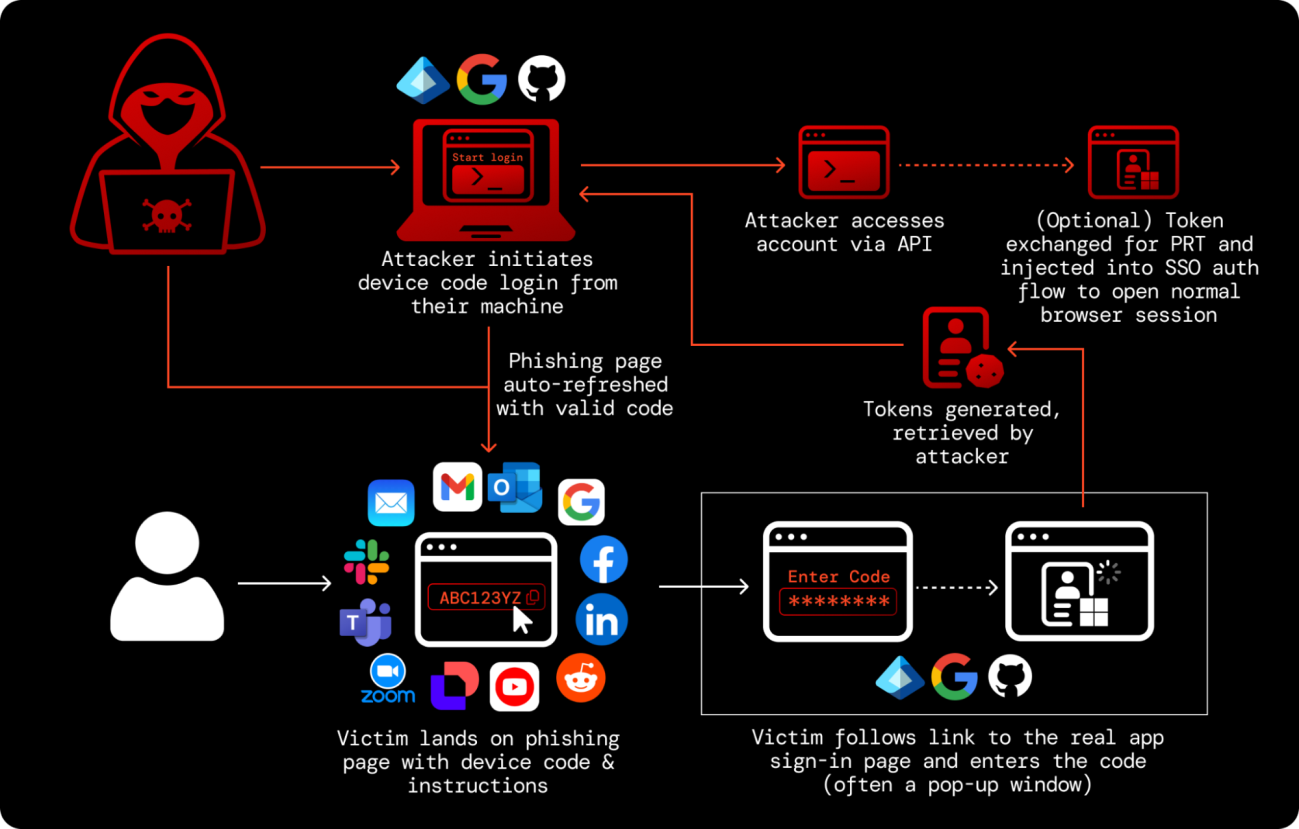
Figure 1: Device code phishing flow, from attacker-initiated login to token capture.
Why it’s dangerous
| Bypasses MFA / passkeys | Evades detection | Durable access |
|---|---|---|
| Auth happens on the real provider’s domain, so all authentication checks pass legitimately. | No malicious link or fake login form to flag. The infrastructure is genuinely the vendor’s. | Long-lived tokens and rogue device registrations, rather than a one-time password compromise. |
The most commonly phished service is Microsoft 365 / Entra ID, both directly and indirectly via lures that impersonate other brands (like Mimecast) to redirect victims into the real Microsoft login. Separately, the same device-code technique has also been used to attack other platforms’ own OAuth flows directly, including Salesforce and GitHub.
The Pivot
OAuth device-code flow (built for keyboard-less devices like smart TVs) isn’t Microsoft-specific. It’s transferable, so any platform that supports it can be exploited the same way. What began with Storm-2372’s Microsoft 365 campaigns in 2024, then expanded via the EvilTokens PhaaS kit in 2026, has now been transferred to other platforms:
| Platform | Role | Details |
|---|---|---|
| Salesforce | Target | Worst non-Microsoft case so far. Scattered Lapsus$ Hunters (Scattered Spider + ShinyHunters + LAPSUS$) combined vishing with device-code phishing on Salesforce’s /setup/connect page, tricking victims into authorising a fake Data Loader app. Claimed 1,000+ orgs, around 1.5B records exposed. Salesforce’s fix was to remove OAuth device flow entirely (Sept 2025). |
| GitHub | Target | Very effective to imitate. An authorised red-team in 2025 ran an ethical “GitHub Device Code Phishing” campaign against developers with a 90% success rate. Stolen tokens exposed private repos, Actions secrets and CI/CD pipelines, which is a real supply-chain risk. |
| Mimecast | Lure | Not the target but the lure. Fake “device enrolment” pages impersonate Mimecast to push victims through the real Microsoft login, which harvests M365 tokens. |
Common Indicators
Note: The hostnames below rotate often, so use them as patterns to hunt for rather than a fixed blocklist. The parent platforms are legitimate services and blocking them outright will likely break normal traffic. Newly seen subdomains are the ones to look at.
Known abused hosting and redirect domains
| Domain / pattern | What it’s used for |
|---|---|
*.workers[.]dev | Cloudflare Workers. Most common host for the final device code landing page. EvilTokens pages often follow the pattern <lure>-xxx.<name>-s-account.workers[.]dev where the prefix matches the lure theme (adobe-, docusign-, onedrive-, sharepoint-, voicemail-, fax-, quarantine-, page-password-). |
*.vercel[.]app | Hosts redirect logic so the traffic blends in with normal cloud traffic. |
| AWS Lambda URLs | Also used to host redirect logic. |
| Compromised legit sites | Often WordPress. Used as redirectors or staging pages, sometimes chained across several hops. |
| Fake CAPTCHA / Turnstile | Placed in front of the landing page to stop URL scanners and sandboxes from seeing the lure. |
Email and lure indicators
- Sent from genuine but compromised third-party (supplier/partner) mailboxes, so sender reputation checks pass.
- Document-share or notification themes: DocuSign, Adobe Acrobat, OneDrive/SharePoint shared files, voicemail, fax, quarantined email, password expiry, or Mimecast “device enrolment”.
- Links delivered through QR codes, SVG/HTML attachments or Teams invites instead of a plain URL in the body.
- A page showing a short code and asking the user to “verify your identity” by entering it at microsoft.com/devicelogin (or another vendor’s device login page).
Network and web indicators
- Address bar shows a workers[.]dev (or similar serverless) domain while the page claims to be DocuSign, Adobe, Microsoft, etc.
- EvilTokens pages get the code via a POST to
/api/device/start, then poll/api/device/status/<sessionId>until the victim signs in. Both paths can be searched for in proxy logs. - A visit to a newly seen serverless subdomain followed straight away by microsoft.com/devicelogin or login.microsoftonline.com.
Identity and sign-in log indicators (Entra ID / M365)
- Sign-ins with Authentication Protocol / Device Code, especially for users who don’t normally use device code flow.
- Device code sign-ins to Microsoft Authentication Broker or other first-party apps the user wouldn’t normally sign in to this way.
- A new device registration / Entra device join shortly after a device code sign-in (persistence via PRT).
- Token use from an unfamiliar IP, ASN or location shortly after the device code sign-in.
- Spike in Microsoft Graph API activity afterwards, e.g. mailbox searches or new inbox rules (often leads into BEC).
User-side red flags
- Being asked to enter a code on a login page when they didn’t start signing in on a TV, printer or other device.
- Being told a code is needed to “view a document”, “complete enrolment”, etc, anything that seems unusual/suspicious that contains a link and requires input.
References
- Mimecast: OAuth Device Code Phishing Campaigns Surge with EvilTokens Toolkit
- Microsoft Threat Intelligence: Storm-2372 conducts device code phishing campaign
- Microsoft Security: Unmasking EvilTokens
- The Hacker News: ShinyHunters OAuth token abuse pattern
- Praetorian: Introducing GitHub Device Code Phishing
- AppOmni: Scattered Lapsus$ Hunters and the Salesforce supply chain attack
- Sekoia: New widespread EvilTokens kit, device code phishing as-a-service
- LevelBlue SpiderLabs: The Device Code Phishing Tsunami
- ZeroBEC: EvilTokens Returns, Device-Code Phishing Through Legacy Email Aliases